MEET YOUR DIGITAL AGENT

Our Approach

Secure A Free Quote Today
for consultation
0330 133 1449
Agentic AI Solutions for your Business
- Scalable & Business- Focused AI System
- Proven Track Record of Autonomous AI Projects
- Certified AI & Machine Learning Specialists
- 10+ Years Experience in AI Solutions
Services WE OFFER
- Enterprise-Grade Security
- 50+ Global Clients
- ISO 27001 Certified
- 24/7 Autonomous Operations





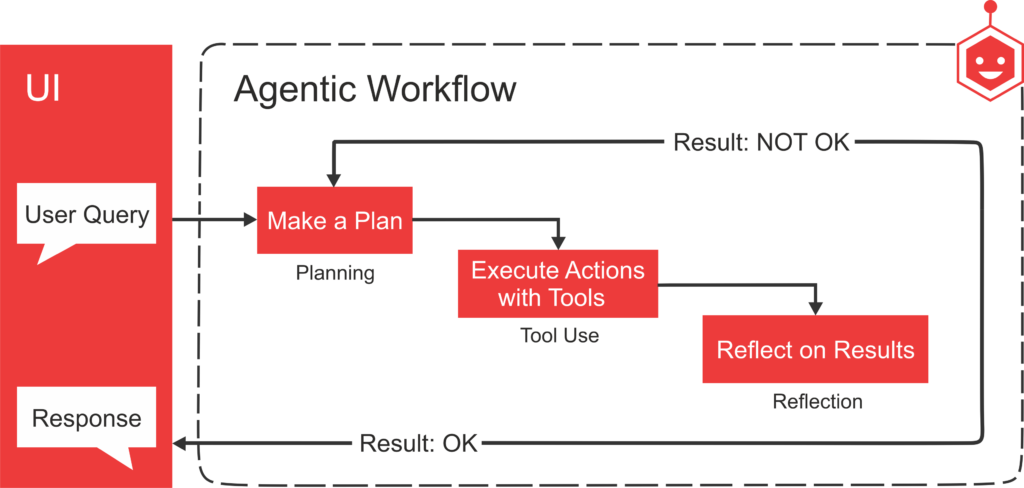
HOW IT WORKS
Goal Definition
Planning & Reasoning
Decision Making
Action Execution
Feedback & Learning
On The Hunt To Hire Top-Talented AI AGENTS ?
Beyond Traditional AI: Systems That Execute
Real-World Agentic AI
Education

Fintech

Healthcare

Retail

Logistics

Telecommunication

Media & Entertainment

Real Estate
Manufacturing

Insurance

CRM

ERP

Empowering Business with Autonomous AI
AI INTELLIGENCE SPECTRUM
Traditional Automation
- Rule- based only
- Follows static if- then logic
- Breaks with edge cases
- Human handles exceptions
- Stops when confused
- Fixed integrations
- Hard- coded connectors
- Expensive to reconfigure
RPA/ Basic AI
- Pattern recognition
- Recognizes patterns in data
- Requires retraining for new scenarios
- Human validates outputs
- Generates confidence scores
- API-dependent
- Pre-built integrations only
- Limited to trained capabilities
Agentic AI
- Goal- driven reasoning
- Understands objectives and chooses optimal paths
- Adapts in real- time to exceptions
- Human sets guardrails, AI handles executions
- Self- corrects or escalates with context
- Dynamic tool selection
- Discovers and uses tools autonomously
- Learns new systems via documentation
Our Agentic AI Team
They decide what the agentic AI should do and how they should interact with users.
They act as a bridge between technical teams and stakeholders.
They decide how multiple AI agents communicate, collaborate, and make decisions autonomously.
They work on learning algorithms, data pipelines, and performance optimization.
Ensuring agents can adapt, reason, and improve over time.
They ensure smooth automation of workflow and real-time interaction between AI agents and company systems.
They collect. clean and organize large amounts of data so AI agents can learn, make decisions and perform task accurately.
Focuses on system stability, performance trackng and continuous improvement of autonomous AI operations.
FAQ
How is this different from the AI tools we're already using?
Traditional AI generates outputs; Agentic AI owns outcomes. While your current tools might summarize data or suggest actions, our agents execute complete workflows—from identifying a need to resolving it across multiple systems—without waiting for human approval at each step.
Can we maintain control over what the AI does?
Absolutely. We implement guardrails at every level: what systems agents can access, what actions they can take, and when they must escalate to humans. You define the boundaries; agents operate within them. Think of it as an autopilot system—you set the destination, the agent handles the route, but you can take control anytime.
What if the AI makes a wrong decision?
All decisions are logged and reversible. Our systems include confidence scoring—when uncertainty is high, the agent escalates rather than acts. Human oversight is always available, and we implement circuit breakers for critical operations. Most clients start with human-in-the-loop mode and gradually increase autonomy as trust builds.
How long until we see ROI?
Pilot implementations typically show measurable efficiency gains within 8-12 weeks. Full ROI is usually realized within 6 months of production deployment. We track metrics like task completion time, error reduction, and human hours saved to demonstrate value at each stage.
Is our data secure with autonomous systems?
Security is architected in, not bolted on. Agents operate within your existing security perimeter, with data encryption, access controls, and compliance auditing built into every interaction. We never use your data to train models without explicit consent, and all processing can happen within your private cloud environment.
What is the failure mode profile of agentic AI compared to humans?
Agentic AI tends to: Fail confidently, Scale errors rapidly, Generalize incorrectly across contexts, Lack true situational awareness.
Humans, by contrast, fail more slowly but with broader contextual grounding.
Are agentic systems economically destabilizing?
At scale, autonomous agents could: Replace entire workflow layers, Reduce middle-management roles, Automate high-skilled labor.
This may cause: Labor displacement, Market restructuring, Increased inequality if benefits concentrate.
What are the legal liabilities of autonomous decision-making?
If an agent: Executes a financial trade, Deploys faulty code, Makes a medical recommendation.
Who is liable?
The deploying organization?, The model provider?, The system integrator?
Regulatory clarity is still evolving globally. Enterprises must design governance frameworks before deployment.
Implementation Roadmap
Stage 1: Discovery & Feasibility

Stage 2: Pilot Development

Stage 3: Production Deployment

Stage 4: Optimization & Scale